
Opinel
In, in Albiez-le-Vieux, a small village in the Maurienne area in the heart of the French Alps in, while working in his father's workshop,Joseph Opinel invents the pocket knife which is now named after him.Led by his passion for machinery and manufacturing processes, he decided to invent an object which he could manufacture using modern techniques. Against his father’s wishes, who preferred hand-made tools and traditional craftsmanship and who was weary of machines, he spent his free time refining the shape and manufactured of a small pocket knife: the Opinel was born!
 Joseph opinel
Joseph Opinel had the idea of making his knife into different sizes which would be suitable to different hand sizes or used for various tasks. So, in 1897, he developed 12 different sizes numbered from 1 to 12. The smallest knife, named No. 1, included a ring so that it could be attached to the chain of a pocket watch. Its manufacture as well as No. 11’s was stopped in 1935. Nowadays, the smallest Opinel, No. 2, has a 3.5-cm blade and the largest knife, No. 12, a 12-cm blade.
His knives soon become very successful. Joseph needed to manufacture large quantities, so in 1901, he sets up his first business next to the family workshop. He left his father’s blacksmith workshop and built his new factory at the Pont de Gevoudaz near the family workshop. In this new building, he streamlined production and developed machines which could manufacture handles at greater speed.
 1890 - The first Opine workshop
In 1915, the company is moved to Chambéry (Cognin). This is the start of a fantastic adventure!Being at the heart of a large railway and road network was an important asset and from this year, Joseph, assisted by his two sons, Marcel and Léon, began the industrial and commercial development of the Opinel brand. In January 1926, a wood-burning stove which had been badly put out started a fire which destroyed the entire building. The Opinel family dealt with this disaster and decided to build new modern premises better suited for their production. Within a few months, a modern factory was built and inaugurated in 1927.
At first, the Opinel knife had four components: the blade, the handle, the shell ring and the rivet. The shell ring was needed to firmly rivet the blade to the handle. In 1955, Marcel Opinel, wanting to improve the safety of the knife, invented the Virobloc® system. He added a rotating lock which slides on the shell ring, closing the groove and therefore locking the blade in its open position. This is a simple idea but with a complex implementation. In the 90s, the Virobloc system was modified to allow the blade to be locked in its closed position. At first, it was only used on a few references, but by the year 2000, it was added to every Opinel knife.
To facilitate production flows and exchanges within the company, it was decided to gather all business activities in on single site. To do so, headquarters were moved from Cognin to La Revériaz in 2003. Also in the spring of 2016, the company open its first international subsidiary. Based in Chicago, OPINEL USA will distribute and develop the brand in the United States.
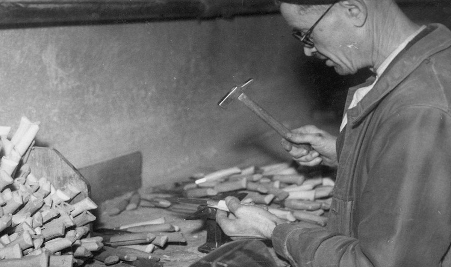
Opinel is a family-owned company and is still run by Joseph Opinel’s descendants. It is still based in Chambéry and employs over a hundred people. This environmentally friendly company is committed to a production which is mindful of natural resources.
For the past 120 years, Opinel has been a loyal companion to nature lovers, cooks,handymen, gardeners, mountaineers, sailors and many more. Loved by the greatest artists and the most famous adventurers and adopted throughout the world as a design reference, it has become a natural extension to the human hand.
Nowadays, from the garden to the table Opinel is the best everyday tool…

Glossary
Carbon steel
Our carbon steel is extremely hard, thereby guaranteeing excellent cutting quality, good wear resistance
and easy regrinding. Carbon can corrode easily. We advise you to avoid damp locations and to wipe and
grease the blade after use.
Stainless steel
We use Swedish 12C27 modied stainless steel (Sandvik). It is extremely anti-corrosive thanks to the
addition of chrome and requires no special maintenance. Its carbon content of at least 0.40% gives
excellent cutting edge.
Convex profile
Opinel blades are ground to an exclusive convex prole. The blade maintains its robustness and can be
ground eciently.
Virobloc
Invented by Marcel Opinel in 1955, the Virobloc safety ring is tted to all folding knives from the No. 06.
Cut out of stainless steel, the Virobloc has two sections, one xed and one sliding. In addition to locking
the blade open (safety in use), it is now possible to lock the blade closed (safety in transport).
Wood
To avoid harming the environment (pollution due to transport, deforestation, etc.), 95% of wooden
handles come from French logging.
Made in France
All our pocket knives and tools are manufactured in our factory at Chambéry in Savoie.